
Choosing the right community, whether it’s a neighborhood, subdivision, or master‑planned development, often has a bigger impact on long‑term happiness and costs than the house itself.
The goal of community research isn’t to find perfection. It’s to reduce regret by balancing lifestyle fit, affordability, and future risk using consistent, verifiable data — not marketing claims.
Below is a practical, data‑driven framework homebuyers can use to compare communities side by side, validate listing claims, and build a repeatable “community due diligence” checklist for both resale neighborhoods and new construction.
A Quick Guide to Choosing a Community Based on Data
When comparing communities, buyers should focus on six core data categories:
Safety and emergency services (crime trends, response proximity)
Schools and education options (beyond a single rating)
Real estate and affordability (pricing trends, absorption, carrying costs)
Zoning, development, and future change (what could be built nearby)
Climate risk and infrastructure resilience (flood, fire, heat, utilities)
These categories work for any metro, whether you’re choosing between two different cities or comparing new construction communities on opposite sides of town.
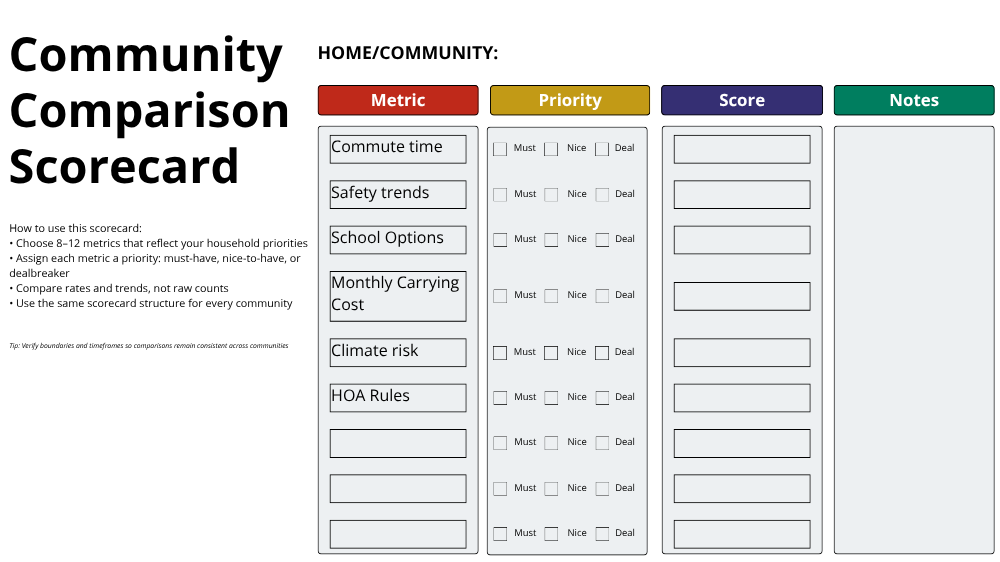
A Simple Community Scorecard Framework
Before touring every option, use a quick scorecard to narrow your shortlist.
Step 1: Pick 8–12 Metrics That Match Your Priorities
Examples:
Commute time
Safety trends
School options
Monthly carrying cost
Climate risk
HOA rules (if applicable)
Step 2: Set Thresholds
For each metric, label it:
Must‑have
Nice‑to‑have
Dealbreaker
Step 3: Normalize the Data
Compare rates, not raw counts (per capita, per household)
Use multi‑year trends, not single snapshots
Make sure boundaries match the actual neighborhood or subdivision
The Top 12 Community Metrics Buyers Should Compare
This list is designed for online search and quick side‑by‑side use:
Average commute time (and variability)
Walkable access to daily essentials
Crime rate trend (not just one year)
Distance to emergency services
School options and enrollment trends
Median price and price‑per‑square‑foot trend
Absorption rate (how fast homes sell)
Property tax rate and reassessment rules
Insurance risk indicators (especially flood/fire)
Typical utility and energy costs
Zoning and planned development nearby
Internet availability and redundancy
Key Metrics, Explained
Crime Rate (Trend, Not Snapshot)
What it is: Reported crime per capita over time
Why it matters: Trends show whether safety is improving or deteriorating
Good rule of thumb: Compare 3–5 year trends, not a single year
Where to find it: FBI Crime Data Explorer (national, state, city)
Absorption Rate
What it is: How quickly homes sell in a specific area
Why it matters: Signals demand, pricing power, and resale liquidity
Interpretation: Faster absorption generally indicates stronger demand
Where to find it: Request local MLS data from your real estate agent, if you’re using one, or use housing permit context from NAHB
Price‑to‑Income Ratio
What it is: Home prices relative to local household income
Why it matters: Indicates affordability pressure and long‑term sustainability
Where to find it: U.S. Census Bureau, American Community Survey (ACS)
Flood, Fire & Heat Risk
What it is: Forward‑looking climate risk at the property level
Why it matters: Affects insurance costs, maintenance, and resale demand
Where to find it: Risk Factor (First Street Foundation, nonprofit) via U.S. Climate Resilience Toolkit
Energy & Utility Costs
What it is: Typical household energy expenditures by area
Why it matters: Utilities are a major, recurring cost, especially in hot or cold climates
Where to find it: U.S. Department of Energy LEAD Tool
Location Data: Go Beyond “Close to Work”
Instead of distance alone, evaluate:
Average commute time and how it changes by day and hour
Return‑to‑office risk: What happens if policies change?
Transit reliability, not just availability
Where to find it: ACS “Journey to Work” tables (commute times by area)
Demographics: Use Responsibly to Understand Fit
Helpful indicators include:
Age and life‑stage mix
Owner vs. renter concentration
Income distribution and employment sectors
Where to find it: U.S. Census Bureau, ACS profiles
Schools: Look Beyond a Single Rating
Instead of relying on one score:
Review graduation rates and enrollment trends
Check program availability (STEM, arts, language immersion)
Pair data with school tours and parent feedback
Where to find it: Check out the school sections in NewHomeSource’s relocation guides, or the U.S. Census Bureau (education attainment, enrollment trends)
Zoning & Development: Avoid Surprise Neighbors
Before making an offer, check:
Allowed density and land use nearby
Planned road expansions or commercial projects
Public comment timelines
Where to find it: Local city or county planning department websites (zoning maps, permit dashboards)
New Construction Communities: Extra Due Diligence
For brand‑new communities still in development, add these checks:
HOA budget or reserve plan (even if preliminary)
Rules on rentals, parking, and exterior changes
Phasing plan: what will be built later and where
Builder incentives can be valuable, but they should be weighed against long‑term resale dynamics, not just upfront savings.
Market Context (2026): How to Adapt Your Strategy
Many markets are more balanced than in recent years. That means:
Verify conditions locally, not nationally
Use data to support negotiation (price, incentives, rate buydowns)
Prioritize operating costs and resilience over short‑term hype
Final Pre‑Offer Community Checklist
Before making an offer, confirm:
Scorecard completed for top communities
Day, night, and weekend visits
Climate risk and insurance quote for the exact address
Zoning and development pipeline checked within a practical radius
HOA documents reviewed (if applicable)
Bottom Line
The best community choice isn’t about chasing a label like “hot” or “up‑and‑coming.” It’s about consistent, verifiable data that aligns with how you actually live — and how the area is likely to change over time.

Jamie Gonzalez
Jamie is a seasoned content manager and copywriter with over a decade of experience in editorial strategy, SEO, and digital storytelling. With a Master’s in Mass Communication and a passion for crafting engaging content, Jamie specializes in creating and optimizing brand voices that resonate across digital and print platforms. She has worked across industries, including real estate, health, and finance, with a commitment to delivering high-quality, impactful narratives.