

The traditional image of a homebuyer has long been tied to growing families and multiple children. But over the past several decades, family patterns in the U.S. have shifted in meaningful ways, and housing preferences are changing alongside them.
More adults are forming households later in life, having fewer children, or choosing not to have children at all. These trends are quietly influencing how homes are designed and what buyers value most.
More Households Without Children
Across all demographic groups, a growing share of adults now reaches their early 40s without children. This highlights an important shift: household formation is no longer the same thing as family formation. A comparison between U.S. Census data from 1980 and from 2024 analyzing children by women age 40-44 broken down by race/ethnicity is shown below.
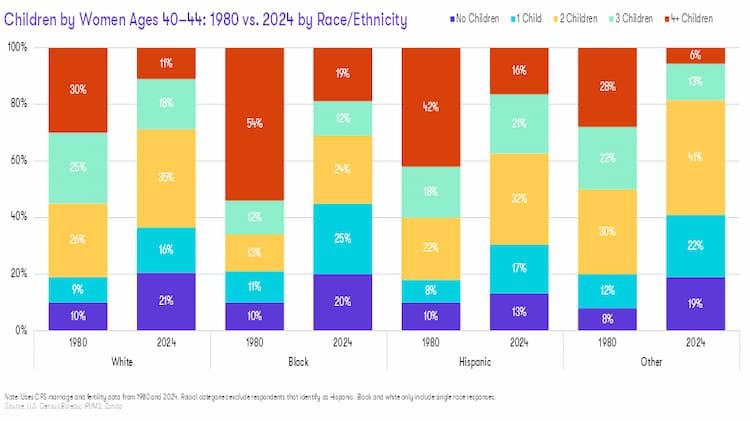
For housing, that supports continued demand for smaller homes, townhomes, condos, and rental communities designed for long-term living rather than short-term family expansion.
Smaller Families Are Becoming the Norm
Among households with children, family size has also changed. Two-child households are now far more common than larger ones, while one-child households continue to grow. Families with four or more children make up a smaller share of the population than they did decades ago.
Even among groups that historically supported larger families, average household size has moderated over time. This shift affects everything from bedroom counts to how much space buyers truly need.
Flexible Spaces Matter More Than Ever
As family structures diversify, flexibility has become a key priority. Instead of dedicating every extra room to a child’s bedroom, many buyers want spaces that can adapt.
“Home offices, guest rooms, fitness areas, and hobby spaces are often just as important as additional bedrooms,” says Ali Wolf, chief economist for NewHomeSource. “Open layouts and multipurpose rooms give homeowners the ability to adjust how they use space as their needs evolve.”
What This Means for Today’s Buyers
Smaller households don’t mean weaker housing demand. In fact, demand can remain strong even as family sizes shrink. Single adults, couples without children, and multigenerational households all play a role in today’s market.
For buyers, these trends translate into more choice. Communities are increasingly offering a mix of home sizes and layouts, making it easier to find a home that fits your lifestyle rather than a one-size-fits-all model.


