

When most homebuyers think about must-have features, air conditioning often tops the list, especially during the peak of summer. But new state-by-state Census data shows that access to AC varies dramatically across the country, and those differences can offer valuable insight for families navigating the housing market.
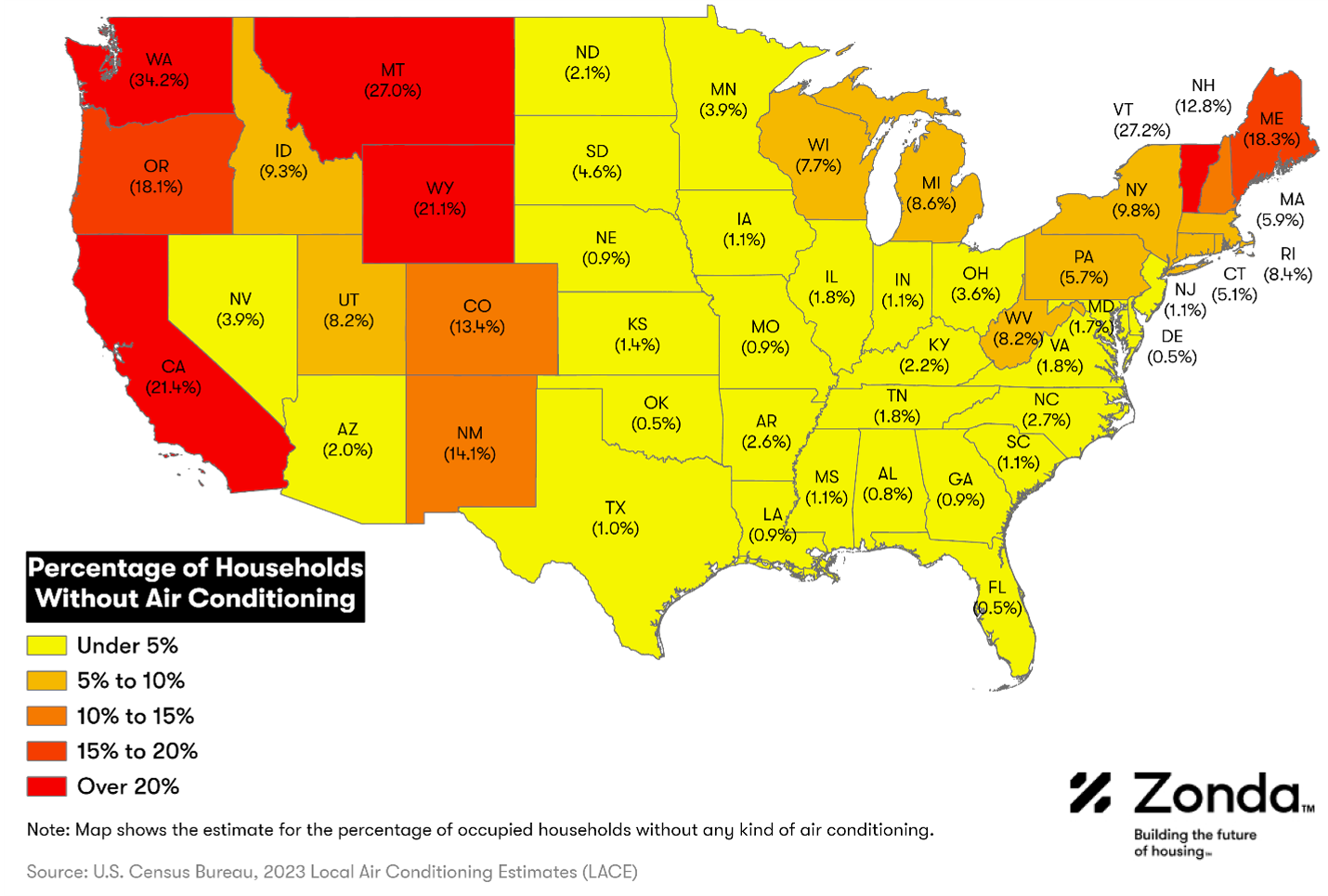
The map below highlights a clear geographic trend. Households without air conditioning are far more common in cooler, coastal, and northern states, while much of the South and Midwest have near-universal AC adoption. Understanding these patterns can help buyers anticipate what to expect in different markets.
The West Leads in Homes Without AC
Western states dominate the list of places where air conditioning is less common. Washington leads the continental U.S. with 34.2% of households lacking AC, followed by Montana at 27% and California at 21.4%. Wyoming is close behind at 21.1%, while Oregon and Idaho still show notable shares at 18.1% and 9.3%.
Even in states known for warm weather, geography plays a role. Coastal climates and cooler nighttime temperatures reduce the need for mechanical cooling, and many older homes were built without it.
For buyers, that means listings may not always include AC, and adding a system could become part of the overall home investment.
The South Makes AC a Standard Feature
In contrast, the South offers a very different experience for homebuyers. In states like Florida, Delaware, and Oklahoma, just 0.5% of households lack air conditioning. Texas is similarly low at 1%, and states such as Georgia, Louisiana, and Alabama are all under 1%.
In these regions, AC is not considered optional. It is a baseline feature built into nearly every home, giving buyers more consistency when evaluating properties. For anyone relocating from cooler areas, this can mean fewer surprises and no need for immediate upgrades.
What This Means for Buyers
These regional differences can shape both expectations and budgets during your home search. In markets where air conditioning is less common, buyers may find lower home prices but should plan for potential installation costs. In regions where AC is standard, it is typically already factored into the price of the home.
Ultimately, understanding where AC is common and where it is not can help you ask the right questions, avoid unexpected expenses, and choose a home that keeps you comfortable year-round.


