

When people think about housing demand, they usually focus on job growth or people moving into a city. But another force is just as important, especially for families planning their next move: where babies are born. Birth rates do not cause instant shifts in housing markets, but over time they create a steady and reliable pipeline of future renters, buyers, and move up households.
What is the data telling us?
Looking at recent 2025 U.S. Census Bureau birth data on a per person basis highlights something important for home shoppers. Some markets are building demand from within, not just relying on people moving in from elsewhere. This kind of organic growth often leads to more stable neighborhoods, longer lasting communities, and housing demand that holds up through different market cycles.
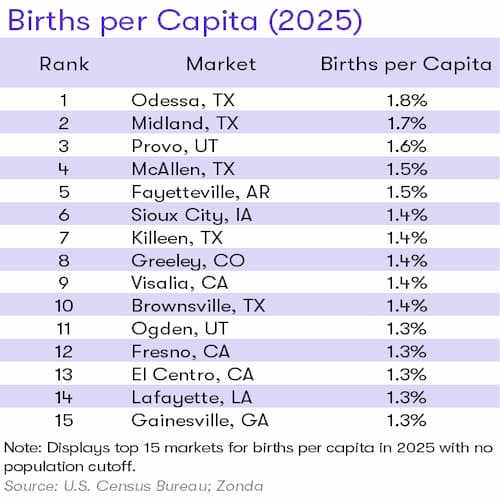
One of the clearest patterns shows up in smaller and mid-sized markets, particularly across Texas, the Mountain West, and parts of the Midwest. Places like McAllen, Brownsville, Midland, Provo, and Ogden are seeing higher birth rates relative to their population.
These areas tend to attract younger households, offer more attainable home prices, and support family friendly lifestyles. Over time, that combination helps sustain demand for schools, parks, and new home communities designed with families in mind.
In contrast, many larger and more established metros show slower natural population growth. Higher living costs, older populations, and delayed family formation can limit the number of new households being created locally. While these markets may still grow through people relocating for work, their housing demand can be more sensitive to economic shifts and affordability pressures.
Why does this matter as a new home shopper?
For home shoppers, this matters because family driven growth often leads to more thoughtful community planning.
“Markets with higher birth rates are more likely to invest in schools, kid-friendly amenities, and neighborhood layouts that support long term living,” said Ali Wolf, chief economist for NewHomeSource.
Builders in these areas also tend to offer floor plans with flexibility, space to grow, and features that evolve as households change.
Geography plays a role too. Fewer Northeast and Pacific Northwest markets rank highly when it comes to births per person, while more affordable inland regions stand out. This reinforces a broader trend many buyers are already feeling: family life can be easier to plan and sustain in places where housing costs leave room in the budget for everything else.
As you search for a new home, it can help to look beyond short-term headlines and consider where communities are growing naturally. Areas with strong family formation today are often the ones building the neighborhoods of tomorrow.
