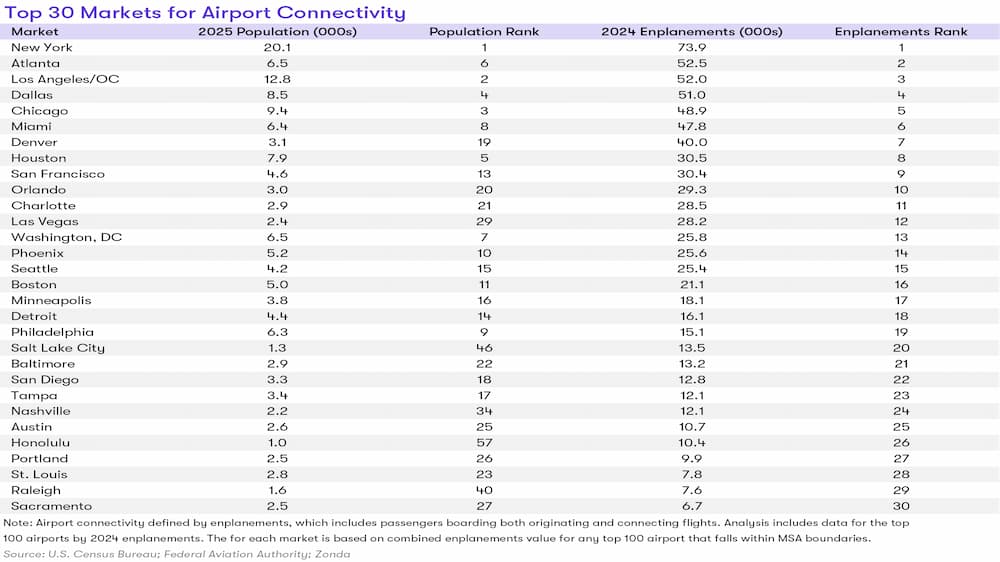
Population growth has long been a go to measure for understanding where housing demand might rise. But in today’s world of remote work, flexible schedules, and regional travel, population numbers alone do not tell the full story. One increasingly useful signal comes from airport activity and how busy a city’s airport is compared to the size of the local population.
What Airport Traffic Shows About a City’s Strength
Airports are more than travel hubs. They are gateways that connect people, jobs, and businesses to the rest of the country and the world. When an airport handles far more passengers than a city’s population ranking might suggest, it often points to a market with strong connectivity, economic importance, and room to grow.
In some metros, airport traffic significantly outpaces population size. This usually means the city serves as a regional or national hub, supporting business travel, tourism, and corporate expansion. That level of connectivity can attract employers and workers alike, which eventually feeds into housing demand. More jobs and easier access often translate into more people looking for homes nearby.
On the flip side, markets where population growth exceeds airport activity may face limitations. Sometimes this is because travel is spread across multiple airports, but in other cases it reflects more limited access. Reduced connectivity can make it harder for businesses to expand and for workers to stay mobile, which may slow long term housing momentum.
What This Means for Your Home Search
For homebuyers, this relationship matters because strong transportation infrastructure often supports economic resilience. Cities with well-connected airports tend to weather downturns better and recover faster, helping stabilize local housing markets. These areas may also offer more diverse job opportunities, which can be appealing for households planning ahead.
This does not mean every buyer should move near an airport. Instead, it is about understanding the broader ecosystem. A busy airport often signals investment, accessibility, and regional importance, all factors that can support housing demand over time.
“As you evaluate where to buy a new home, consider how easy it is to get in and out of the market,” said Ali Wolf, chief economist for NewHomeSource.
Strong connectivity can quietly support job growth, lifestyle flexibility, and long-term value, even if it is not always obvious at first glance.